
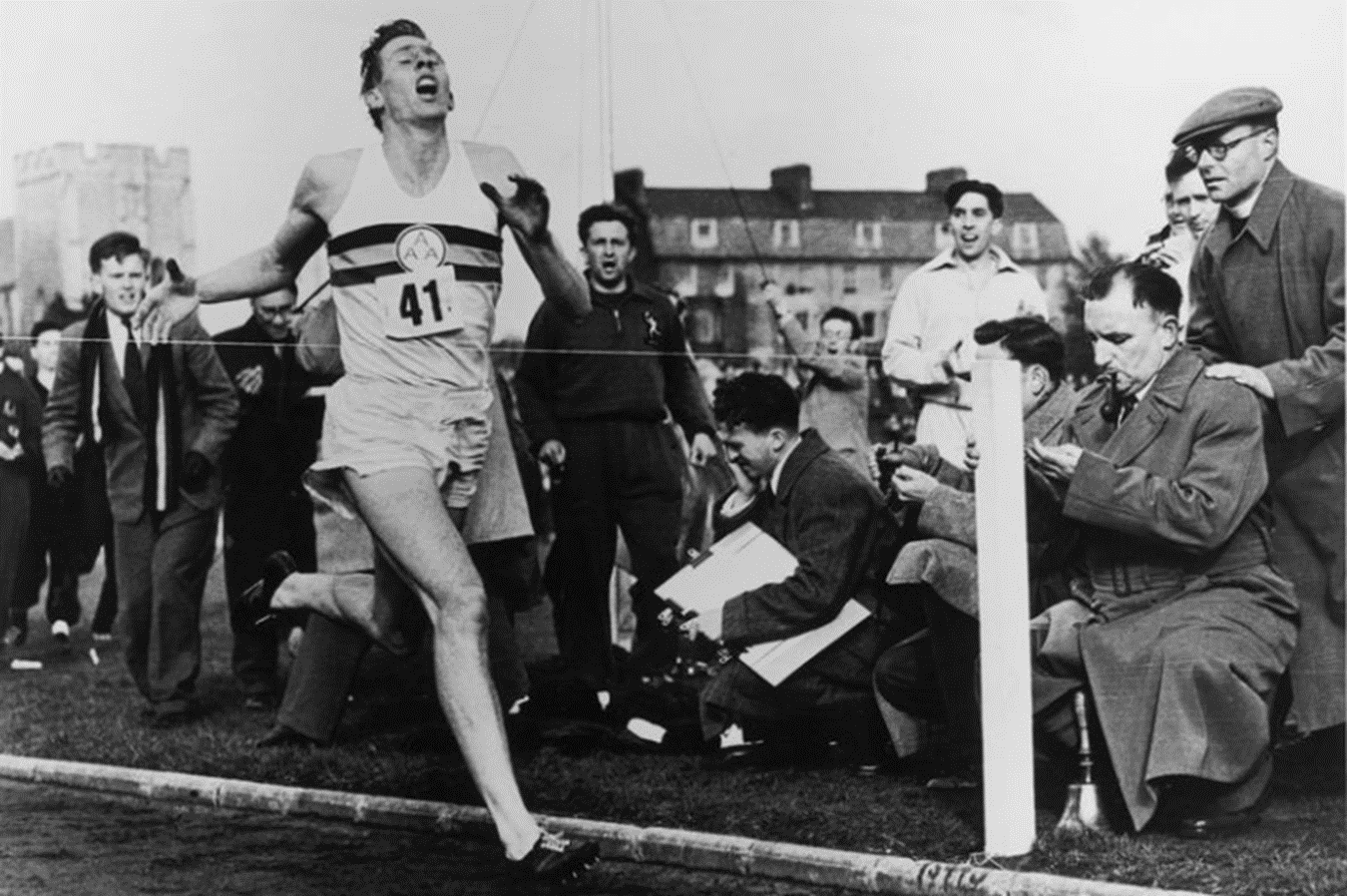

65 years since the 4-minute mile breakthrough
The 6th of May is the anniversary of Roger Bannister’s break-through of the 4 minute mile. It’s difficult now to grasp the scale of the achievement in the context of that time. Mount Everest had just been scaled for the first time the year before. There was an anticipation of better things ahead now that World War II was receding into the more distant past. However, most people genuinely believed that it was humanly impossible to run a mile in less than 4 minutes – the barrier had stood and had been talked about for everyone’s lifetime up to that point.
What happened next tells us a lot about the barriers we carry around in our minds and how they can be broken. Within 46 days of Bannisters 3 minutes 59 seconds record, Australian John Lang ran the mile in 3 minutes 38 seconds. Within a year, 3 different people had broken the barrier in the same race. Our own Ronny Delaney became the 7th person to run a mile in 4 minutes the next year. Roughly 1,400 male athletes have broken the 4 minutes smile barrier in the 65 years since Bannisters achievement and the current record is 3 minutes 43.13 seconds. The fastest female athlete over a mile to date is Svetlana Masterkova with a time of 4 minutes 12.56 seconds. That record will eventually go too.
So why did a drought turn into a flood? What did Bannister teach the others to enable them to follow him? Actually, there was very little they could copy from him. What changed was their mindset. The key mindset transformation was that, not only can this be done, but this is the new standard which every world class middle distance male athlete needs to achieve to be credible. The question was no longer “who among our peer group of world class athletes would do it first?” and transformed to “if I am who I really believe me to be, then this is clearly something I can and must do”.
The starting point for a business coach engagement is working on the “if I am who I really believe me to be …” piece. The standard or objectives which “must and can” be achieved is addressed with written personal and business vision statements. These become the navigational aids essential to dealing with the stuff that happens which distracts you from your plan and range of other challenges including, perhaps, dealing with fear of failure. They are also a key first step to proper analysis, plan and execution to deliver on the objectives.
We all have at least 10,000 decisions to take in the course of every day dealing with everything from what to eat, where to sit, etc. We do not possess the mental capacity to think deeply about each of these decisions. We use filters which enable us to make sense of the chaos of the day and enable our minds to function. These filters are an amalgamation of mental meta-programs, values, beliefs, past decisions and memories. Properly done, working on those vision statements can have a positive effect on how those filters work for you. Doing the things which get you to where you want to go become a lot easier and a lot clearer when you have a written down statement to yourself of what the destination looks like.
If this all makes sense to you, then get yourself a business coach and get started. Every one of the 1,400 plus athletes who have run a mile is less than 4 minutes feel a fellowship with Roger Bannister, but they also feel a fellowship with all the other people who have shared their achievement in acknowledgement of the similar journey travelled. Getting a business coach is also a step taken by outstanding business achievers globally. Join the club!